Twenty’s Plenty.
Not owning a car is a great way to stay fit, save money, and avoid loads of hassle. This is a blog with thoughts, photos, ideas and links about carfree life: walking, active travel, public transport, places and spaces - things that matter to everyone, but even more when you don’t own a car. Photos are by me unless credited. Forthcoming: book on carfree life. Meantime, get in touch via email at carfreelifeoutsidethebox@gmail.com or Twitter @carfreebrighton
Showing posts with label 20mph speed limit. Show all posts
Wednesday, 28 January 2015
Thursday, 22 January 2015
20mph - saving lives and reducing traffic injuries in Brighton and Hove
Great to read that our council is going to extend the 20mph speed limit to most of the city, especially given that the existing 20mph speed limits seem to be having an impact on road crash deaths and casualties.
Also great to see Lead Councillor for Transport Ian Davey’s comment in The Argus, “Maybe the time is coming to change the default speed limit in urban areas to 20mph from 30mph.” Sounds like the sort of thing that a behavioural economist would say. So Amen to that!
Friday, 4 April 2014
GLA says “20 is Plenty” for more of London
The Greater London Assembly Transport Committee has released Feet First – Improving Pedestrian Safety in London.
This is in response to the risks and challenges for pedestrian safety in the capital: after years of decline, the numbers of pedestrians killed and injured in London is rising - 69 pedestrian deaths and 1,054 seriously injured in London in 2012.
The report (with its Abbey Road lookalike cover shown above) states that a key policy option is to reduce speed limits from 30mph to 20mph to create a fairer balance between people and motor vehicles, with proposed actions including investigations to consider increasing the percentage of London’s road network that is covered by 20mph limits (from the current level of 19%) to 50% by 2016. More on this at 20’s Plenty.
Labels:
20mph,
20mph speed limit,
Abbey Road,
Greater London Assembly,
London,
Pedestrians
Tuesday, 17 December 2013
20mph in Brighton and Hove: it ain’t over yet
As per previous blogs, Brighton and Hove will be getting a whole lot more roads where 20mph is the speed limit - great news for pedestrians and cyclists, and should help with the move towards living streets. But interventions by Labour and Conservative councillors mean that some roads have been wrongly excluded: Preston Drove and Stanford Avenue lost out due to a proposal by Labour
Councillor Gill Mitchell, supported by other Labour and Conservative councillors, to exclude the roads on the basis that they were "key bus and taxi routes and a majority of residents in both roads having voted against these roads being included within the 20mph scheme." These roads are NOT key routes for buses (which only use sections of the roads or are infrequently scheduled), and the residents’ response rate was only around 20% almost evenly split, for and against. You can sign the petition to save lives and restore some balance to these roads. Remember, it only needs 1,250 signatures to trigger a full council debate.
Further amendments by Conservative Councillor Geoffrey Theobald and the Labour Group had Surrenden Road, Braybon Avenue and an area west of Ditchling Road denied 20 mph speed limits despite overwhelming road safety evidence to support speed reduction, and a community road safety campaign. Also, due to amendments, Portland Road has to await further monitoring.
Thanks to Tony Green and Becky Reynolds from Bricycles for the above links and info www.facebook.com/Bricycles
Further amendments by Conservative Councillor Geoffrey Theobald and the Labour Group had Surrenden Road, Braybon Avenue and an area west of Ditchling Road denied 20 mph speed limits despite overwhelming road safety evidence to support speed reduction, and a community road safety campaign. Also, due to amendments, Portland Road has to await further monitoring.
Thanks to Tony Green and Becky Reynolds from Bricycles for the above links and info www.facebook.com/Bricycles
Labels:
20mph,
20mph speed limit,
Bricycles,
Brighton and Hove
Friday, 13 December 2013
Six thoughts about Phase 2 of 20mph in Brighton and Hove
As the dust settles on last Wednesday’s meeting of Brighton and Hove City Council’s Environment and Transport Committee on extending the existing 20mph zone outwards from the centre of the city, following are some thoughts. In the form of current flavour of the month, a listicle:
1. In the UK there are now 12 million people living in 20mph areas. With the implementation of Phase 2, this will rise to 12 million + the population of Brighton and Hove covered by the second phase, minus those who live along the roads which have been excluded due to a) the original plan and b) Conservative and Labour amendments. (Ditchling Road, Surrenden Road, Braybon Avenue (including Old Farm Road and Graham Avenue) and Carden Avenue (excluding the Carden Avenue service road). Map
2. Hundreds more streets in Brighton and Hove will be covered by a 20mph speed limit. As this article points out.
3. 20mph is enforceable. It’s no different from any other speed limit, as has already happened in Brighton and Hove, where 50 drivers were stopped by the police for exceeding the 20mph limit.
4. 20mph is uncontroversial elsewhere. While a policy that is demonstrated to reduce the numbers of Killed and Seriously Injured (KSI) in other parts of the UK and Europe is uncontroversial, for reasons best known to themselves (because they haven’t said why), a 20mph default speed limit seems to have huge symbolic value for Brighton’s would-be “unchained” motorists.
5. Beware of “common sense.” When those two words are used, its time to turn the bullshit detectors up to max. Common sense, as per the adverts from the Unchainers, is just another way of saying, “there is no evidence for what I’m going to say next.” Here’s an example, from Unchain’s latest advert.
“Victory for common sense. Thank you to the Conservative and Labour councillors for listening to the majority of people who did not want to see a 20mph speed limit in nine areas of the city.”
And here’s some more common sense, a verbatim comment taken from the Unchain Facebook site:
“Roads are for cars teach people to respect their own space and that of cars. Cars can kill, so I take care when driving n ask that pedestrians respect me - even fear e a little. The raod is for cars. Beware and be aware. Take care out there n stop trying to pad out life. Live with care, in everything.”
6. We’ll wonder what all the fuss was about. Over time, 20mph will become the norm in British cities. People will get used to it and looking back, will wonder what all the fuss was about. Like the smoking ban. Apart from a few diehards, who would now go back to the days when pubs, restaurants and other venues were full of smoke? And, as this report shows, the smoking ban has had a major impact. In the same way, 20mph will make things better for everyone: safer, quieter, more inviting, less threatening, more sociable. What’s not to like?
Thanks to Becky Reynolds for the photo.
Monday, 14 October 2013
A Thought Experiment on 20mph
Imagine that urban speed limits throughout the UK are 20mph, and have been for years. They work well, and we are used to them. A new Transport Minister has just been appointed, and makes a speech with this statement:
“The average urban journey in the UK is taking around 40 seconds more than it would do if the speed limit was 30mph. So we propose to increase urban speed limits by nearly 50%, to 30mph. Of course, we realise that this means that fewer people will walk or cycle, so there is likely to be more obesity in years to come; as a consequence, there are likely to be more cars on the road, meaning more congestion; cities will become more congested and dangerous. We also recognize that more people, especially children and old people, will die or be seriously injured in car crashes.”
How long would the Minister stay in the job?
“The average urban journey in the UK is taking around 40 seconds more than it would do if the speed limit was 30mph. So we propose to increase urban speed limits by nearly 50%, to 30mph. Of course, we realise that this means that fewer people will walk or cycle, so there is likely to be more obesity in years to come; as a consequence, there are likely to be more cars on the road, meaning more congestion; cities will become more congested and dangerous. We also recognize that more people, especially children and old people, will die or be seriously injured in car crashes.”
How long would the Minister stay in the job?
Thursday, 3 October 2013
20mph: Plenty for Brighton and Hove - but it’s 10mph too fast for Hove’s celebrities
Labels:
20's Plenty,
20mph,
20mph speed limit,
Adele,
David Walliams,
Fatboy Slim,
Laura Stone,
Norman Cook,
Zoe Ball
Friday, 10 May 2013
Talking Twenty: Challenging the Myths about the 20mph Speed Limit
Yesterday morning I rocked up to the Hove Business Association breakfast at Sussex County Cricket ground in Hove, put on my Living Streets hat and delivered a talk on “Why 20 is Plenty: Challenging the myths about the 20mph speed limit." I’d been warned that the tomatoes were ready (why?), but none were thrown and the audience was very attentive, asking a wide range of questions – mostly about enforcement, and the attitude of pedestrians.
A couple of delegates said that they had been sceptical, but had been convinced by my use of evidence-based analysis. That was encouraging. I reckon that, in a few years time, when 20mph has become the default speed limit in UK urban areas (as it is in much of Europe), we will wonder what all the fuss was about. Click here for my slides.
Scary graphic from Complete Streets Chicago, showing stopping distances and driver’s eye view at various speeds – including the unseen pedestrians.
Tuesday, 7 May 2013
Talking Twenty: Challenging the Myths about 20mph
This Thursday 9th May, I’ll be donning my Living Streets Brighton and Hove hat and giving a presentation at the Hove Business Association Business Breakfast. The talk is entitled “Why 20 is Plenty: Challenging the myths about the 20mph speed limit." More details here.
Thursday, 25 April 2013
Blues and Twos and 20mph
“Your story (April 20th) about emergency services potentially having to slow down when answering calls as a result of the new 20 mph speed limit in Brighton and Hove ignores a couple of crucial points.
First, if motorists are obeying the 20mph limit, those crashes that happen will result in fewer serious injuries – meaning that the emergency services will not have to undertake as many life-saving high speed dashes around the city. Secondly, high speed responses by emergency service vehicles can themselves have serious consequences. As an article in the Emergency Medical Journal of the British Medical Journal has noted, “The risk of road traffic accidents is associated with the increased speed of a vehicle, and this phenomenon equally applies to responding emergency vehicles.”
It was unfortunate that Hove MP Mike Weatherley described the slow-down as “an arbitrary change that might put lives at risk,” when the evidence shows that it is more likely that the 20mph speed limit will not just save lives, but also increase the quality of life for everybody who visits, lives in, or works in, Brighton and Hove.”
Wednesday, 10 April 2013
Accentuate the Positive: Reframing 20mph
Friday, 25 January 2013
20mph –It’s About Behaviour, Not Just Enforcement
One of the arguments sometimes used about default 20mph speed limits, coming soon to Brighton and Hove, is that they are “unenforceable.” These extracts from a briefing by 20’s Plenty show that gaining widespread driver compliance involves much more than relying on police enforcement - the aim is for drivers to voluntarily slow down.
Even on isolated streets simply altering signs from 30 to 20mph brings about a 2mph reduction in speed and crashes fall by 10%. When implemented widely, falling maximum and average speeds bring important quality of life gains. On faster roads self-enforced reductions in average speed can be 7mph.
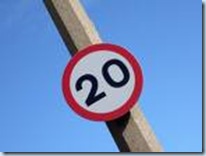
As 20’sPlenty say, reducing community limits to 20mph is all about social behaviour change rather than traffic engineering. Generally, 20mph limits should be self enforcing. Motorists must realise that streets are also where people live, shop or enjoy leisure.
Rather than just putting “signs on sticks”, successful limit schemes include so much more:
Full briefing with references.
As 20’sPlenty say, reducing community limits to 20mph is all about social behaviour change rather than traffic engineering. Generally, 20mph limits should be self enforcing. Motorists must realise that streets are also where people live, shop or enjoy leisure.
Rather than just putting “signs on sticks”, successful limit schemes include so much more:
- Engagement before road signs change
- Community-wide 20mph limits applying to the vast majority of streets - e.g. 94% of Portsmouth – so that most drivers gain benefits in their home neighbourhood. Exceptions need to be justified.
- Single-phase implementation - or, if roll out is progressive, there’s a need to publically and continuously explain that most streets will be included over time.
- Extensive, sustained social marketing. A multi-agency approach. Heavily selling the benefits helps motorists to understand how and why 20mph improves community life.
- Professional staff with expertise in soft measures including social marketing and internet viral campaigns.
- Community self policing slowing down those behind, social disapproval of speeding, community speed watch, reporting of speeder’s plates, loan of speed guns to activists.
- Occasional light touch enforcement warnings and Fixed Penalty Notices by traffic police. This is on top of extensive engagement. It is not an additional cost to the Police budget since there are the same number of roads and drivers as when enforcing a 30mph limit.
Full briefing with references.
Labels:
20's Plenty,
20mph,
20mph speed limit,
Brighton and Hove
Wednesday, 16 January 2013
Twenty’s Plenty for Brighton and Hove: What A Difference A Frame Makes
Labels:
20mph speed limit,
20s Plenty,
behavioural economics,
framing
Subscribe to:
Posts (Atom)