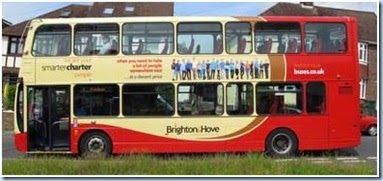
…and
walk a bit. And then get on another bus. Get off. And walk some more! Great to
see Brighton and Hove Buses supporting active travel, with this bus spotted in
Portland Road, Hove.
Not owning a car is a great way to stay fit, save money, and avoid loads of hassle. This is a blog with thoughts, photos, ideas and links about carfree life: walking, active travel, public transport, places and spaces - things that matter to everyone, but even more when you don’t own a car. Photos are by me unless credited. Forthcoming: book on carfree life. Meantime, get in touch via email at carfreelifeoutsidethebox@gmail.com or Twitter @carfreebrighton
Showing posts with label Brighton and Hove Bus Company. Show all posts
Friday, 13 October 2017
Wednesday, 17 June 2015
The road ahead for bus lanes in Brighton and Hove
An issue
raised at last week’s meeting of the Brighton and Hove Transport Partnership
(declaration of interest: I sit on the Partnership as a pedestrian advocate)
was the online petition launched by newly elected Labour Councillor Daniel
Yates. The petition calls on Brighton & Hove City Council to reduce the
hours of the Lewes Road bus lanes, opening them up to all traffic at certain
times of day. Chair of the Partnership, Councillor Gill Mitchell, Labour’s new
lead member for Transport, assured us that bus lanes will not be
scrapped. She also said that the Valley Gardens scheme is on hold pending a
review to ensure it delivers the right (economic) benefits and doesn’t worsen
traffic congestion.
Fair enough, but bus lanes are an essential element of the
Valley Gardens scheme, and if they aren’t dedicated to buses (and taxis, and
bikes, and possibly powered two wheelers), there’s no point in having them. The
clue is in the name.
Taking up the theme, Brighton and Hove Buswatch has
published a long piece in its latest newsletter. Since I can’t improve on it, I
reproduce here (with permission) a few facts
in support of bus lanes in Lewes Road, many of which apply to bus lanes in
other parts of Brighton and Hove:
Brighton and Hove has the highest bus use per head of population anywhere in England outside London. This is a fantastic achievement and good bus priority measures have made this possible.
Bus routes serving Lewes Road carry over 16 million bus journeys each year – that is over 50% more trips than in the entire city of Portsmouth which has a similar population to Brighton & Hove.
Over 60% local residents who responded supported the Lewes Road bus lanes during consultation
More people travel along Lewes Road by bus and bike than by car so it makes sense to give them priority.
One double deck bus can carry 90 passengers in the space of about three cars. Bendy buses can carry 120 or more, so they are very efficient users of road space.
Both Universities are expanding with the University of Sussex aiming to attract 1,000 extra students each year. If even a small proportion of these use cars traffic conditions could worsen significantly. Bus lanes enable students and staff to reach Universities easily.
Experience from London shows that restricting the hours of bus lanes creates confusion for motorists as most traffic regulations apply 24 hours.
Brighton is a 24 hour city – the N25 night bus runs up to every 10 minutes along Lewes Road, so the bus lanes are in use at all times.
Major events at the Amex Stadium involve Park and Ride buses which rely on bus lanes to speed them through traffic.
The past few months have been very difficult for buses due to extremely disruptive roadworks which have often taken longer than planned. As a result bus use in the City has fallen for the first time in twenty years. We must reverse this trend and get back on track with improvements to keep Brighton and Hove moving. Bus lanes are vital to achieve this.
If bus lane
times are restricted, services are likely to suffer. Here are some risks:
Buses could become less frequent and less reliable
Fares may increase because fewer people travel to support the services
Evening services could be cut as these are often subsidised by profitable daytime buses
Congestion and pollution will get worse if more people use cars, so overall traffic levels will increase
Marginal bus services may become unviable, resulting in complete withdrawal unless the City Council funds a replacement service.
Taxi journeys will become slower and more expensive because taxis use bus lanes too
Poor air quality has been mentioned as a reason for opening up bus lanes to reduce traffic queues. Clearly this will not be achieved if bus users transfer to cars and overall congestion increases. Bus companies are currently investing in low emission vehicles but money for new buses has to come from profits from bus services.
The City Council has been monitoring congestion since the first stage of the Lewes Road scheme was completed in 2013, but it was not possible to obtain accurate information while the Vogue Gyratory works were in progress last year. The initial monitoring report showed there was little change in journey times for general traffic along Lewes Road. We understand the spring 2015 monitoring report will be published soon. If it shows there has been increased rat running and congestion on other roads, this can be addressed in other ways. Restrictions can be imposed on through traffic movements and there is already a study into improving traffic flows at the Downs Hotel junction in Woodingdean.
The Buswatch piece goes on to make some excellent suggestions for getting people back on buses, which you can here.
And the MD of Brighton Buses, Martin Harris, has weighed in with a succinct blog post on the links between physical activity (see the previous post on this blog), public transport…and bus lanes.
Friday, 15 August 2014
Spot the difference: On The Buses in Oxford and Brighton
A long weekend in Oxford at the World Humanist Congress 2014 provided the chance to explore the city on foot and by bus. Like Brighton and Hove, Oxford is a city which is now mainly defined by two sectors: education and tourism. Both cities are compact - ideal for pedestrians, bikes (although Oxford is much less hilly than Brighton), and buses.
Oxford’s buses are run by the Oxford Bus Company, Stagecoach and Thames Travel Buses. As in Brighton, buses are modern, accessible, and fairly frequent. Many have on-board wi-fi. As with Brighton and Hove Bus Company, the Oxford Bus Company is part of the Go-Ahead Group. And as in Brighton, there has been a steady growth in bus user-ship in recent years.
Spot the difference.
But as well as the similarities, there are some major differences, especially when it comes to tickets.
In Oxford,passengers can buy a day ticket on a bus (for £4) and use it on all of the city’s buses during the daytime. So it’s cheaper than in Brighton, and it’s fully
interoperable across all bus operators – something where Brighton lags (although it used to be available). Secondly, although it’s called a “Day Ticket” in Oxford, it’s actually valid for 24 hours – much like the system that operates in most cities in the rest of Europe outside the UK, and which provides better value for customers. How come two firms, part of the same plc, have such different policies when it comes to the fare paying bus passenger? Although Brighton and Oxford have their differences, it would be good if some things were a bit more similar when it comes to our city’s buses.
PS: As the Oxford Bus Company has pointed out (via Twitter), it’s part of the same Group, not the same Company: local management can flex policy and practice according to local conditions. Fair enough. But it would be great if best practice (Oxford’s fares and interoperability) could be replicated across the Group.
Oxford’s buses are run by the Oxford Bus Company, Stagecoach and Thames Travel Buses. As in Brighton, buses are modern, accessible, and fairly frequent. Many have on-board wi-fi. As with Brighton and Hove Bus Company, the Oxford Bus Company is part of the Go-Ahead Group. And as in Brighton, there has been a steady growth in bus user-ship in recent years.
Spot the difference.
But as well as the similarities, there are some major differences, especially when it comes to tickets.
In Oxford,passengers can buy a day ticket on a bus (for £4) and use it on all of the city’s buses during the daytime. So it’s cheaper than in Brighton, and it’s fully
PS: As the Oxford Bus Company has pointed out (via Twitter), it’s part of the same Group, not the same Company: local management can flex policy and practice according to local conditions. Fair enough. But it would be great if best practice (Oxford’s fares and interoperability) could be replicated across the Group.
Thursday, 19 June 2014
A Transport of Delight: Brighton and Hove’s new seafront Routemaster service
Hats off to Brighton and Hove Buses for introducing the new seafront bus route, No.10, between Brighton Station and Hove, which started service this week. Here’s hoping that if this heritage bus is a success then it will become a permanent seafront route. Running this summer, the bus used is a 1965 Routemaster named Colin Curtis, a Brighton resident who played a key role in the design of the classic Routemaster, according to Brighton Buswatch. All normal tickets can be used on the bus.

This is the first regular bus service along the seafront for some years. Buses leave Brighton station hourly at ten minutes past each hour and return from Hove’s King Alfred at 31 past the hour. The Routemaster is 60 years old this year – and although it was never a Brighton regular, over 2,700 of these buses were built for London Transport between 1954 & 1968. Routemasters finished service in London in 2005, and there are now around a dozen or so on routes 9 and 15.
As well as providing additional travel options in Brighton and Hove, the No 10 Routemaster offers a journey into nostalgia for those who recall these buses as an essential part of the capital’s public transport. Not only does the no 10 come with the chance to buy a ticket from a conductor, the Routemaster offers that most illicit of pleasures - the ability to enter and exit by the rear platform without the encumbrance of doors. Never mind Proust and his madeleine, for those of us who grew up with Routemasters, Brighton’s No. 10 bus is a remembrance of things past. Ding, ding! Hold on tight. More information, timetable etc here.
Pictures: Routemaster at the Old Steine; conductor Alec
Labels:
Brighton and Hove Bus Company,
madeleine,
Proust,
Routemaster,
seafront
Tuesday, 5 November 2013
Brighton & Hove has highest UK bus use outside London.
Thanks to Brighton Area Buswatch for this item, lifted from their October newsletter. In contrast to the rants of Unchain the Brighton Motorist, it includes facts and evidence about transport in Brighton and Hove.
“Official statistics from the Department for Transport confirm for the second year running that Brighton & Hove has the highest bus use per head of population in England (excluding London). During 2012/13, over 45 million journeys were made by people boarding buses in the Brighton & Hove City Council area. This is around 5% higher than the previous year.

By comparison there were 21 million bus users in East Sussex and 26 million in West Sussex. In Portsmouth and in Medway which are both urban areas with similar populations to Brighton & Hove, the figures were 10 million and 9 million respectively.
Nationally there was a decline in bus use of 2.5%. Even London, which has experienced strong growth in recent years (assisted by enormous Government subsidies), recorded a small decline. Once again this is a tribute to our local bus companies who have worked hard to grow the market against the odds and to the pro-public transport policies of Brighton & Hove City council.” (my emphasis).
And speaking of Unchain The Brighton Motorist, how much money has this cost so far? Eight full page adverts in the Argus, and counting….
“Official statistics from the Department for Transport confirm for the second year running that Brighton & Hove has the highest bus use per head of population in England (excluding London). During 2012/13, over 45 million journeys were made by people boarding buses in the Brighton & Hove City Council area. This is around 5% higher than the previous year.
By comparison there were 21 million bus users in East Sussex and 26 million in West Sussex. In Portsmouth and in Medway which are both urban areas with similar populations to Brighton & Hove, the figures were 10 million and 9 million respectively.
Nationally there was a decline in bus use of 2.5%. Even London, which has experienced strong growth in recent years (assisted by enormous Government subsidies), recorded a small decline. Once again this is a tribute to our local bus companies who have worked hard to grow the market against the odds and to the pro-public transport policies of Brighton & Hove City council.” (my emphasis).
And speaking of Unchain The Brighton Motorist, how much money has this cost so far? Eight full page adverts in the Argus, and counting….
Tuesday, 27 August 2013
A Transport of Delight? Brighton & Hove Buses
According to a presentation by the firm’s MD Martin Harris at a meeting of Brighton and Hove Transport Partnership last month, buses have been a big part of modal shift in Brighton and Hove, with passenger numbers growing from 22 million to 44 million (since 1993, apparently) a growth of 4.5% a year. As the company notes, Brighton and Hove has:
- The highest bus usage per head of population outside London (168, where the England average = 89).
- Consistently high numbers for passenger satisfaction, scoring 89-92% according to Passenger Focus.
- With 85% of passengers having a bus at least every 10 minutes.
Friday, 3 May 2013
On The Buses or In the Car? Brighton & Hove Buses join forces with City Car Club
City Car Club provides hourly car and van rental on a pay as you go basis in Brighton & Hove, and across 13 other cities in the UK. A deal with the Brighton and Hove Bus Company means that, if you hold the key, you can get the first year of membership for £1 instead of the usual £60 (itself pretty cheap – around £1 a week for access to a car when you need it). More details here.
Wednesday, 6 June 2012
Subscribe to:
Posts (Atom)
