Showing posts with label health. Show all posts
Showing posts with label health. Show all posts
Wednesday, 11 November 2015
"Secret of staying fit and healthy is ditching the car and eating homemade meals."
Or so said the headline to a report in the Daily Telegraph a couple of days ago. It sounds like the kind of thing this blog has been saying for quite a while now. But if it’s now in the Telegraph…All based on pukka studies, as you can see here.


Friday, 14 August 2015
Walk This Way (Any Way) to be More Healthy
There are enough quotes in this article on Walking: Your Steps to Health in Harvard Health Newsletter, from Harvard Medical School to provide Quote of the Week for a whole year. The first paragraph alone includes the following:
“…the two-footed upright gait is a banner accomplishment for our species.”
“…walking is one of the things that distinguishes man from all other animals.”
“Walking is an automatic, intrinsic human function, and it serves many practical roles.”
“Walking doesn’t get the respect it deserves, either for its health benefits, its value for transportation, or its role in recreation.”
Quotes aside, what about facts? The Harvard article references a University College London meta-analysis of research published between 1970 and 2007 in peer-reviewed English-language journals. Based on 18 studies covering 459,833 participants who were free of cardiovascular disease when the investigations began, the meta-analysis found that walking reduced the risk of cardiovascular events by 31%, and it cut the risk of dying during the study period by 32%. These benefits applied to men and women, and protection occurred even at distances of 5½ miles per week, walking at about 2 miles per hour. The people who walked longer distances, walked at a faster pace, or both enjoyed the greatest protection.
The article busts a lot of myths, and includes thought-provoking insights into themes such as walking vs running (walkers have one foot on the ground at all times, reducing impacts and hence injuries) and the relationship between walking and calorie burn. Summing up, the article notes,
“Walking has it all. Simple and natural, it doesn’t require any instruction or skill….. You can walk alone for solitude or with friends for companionship. You can walk indoors on a treadmill or outside in the city or country, at home or away. You can get all the benefits of moderate exercise with a very low risk of injury. And to boot, walking is inexpensive…Charles Dickens got it right: “Walk to be healthy, walk to be happy.”
Wednesday, 25 March 2015
Just go for a walk. Go on. Just. Go. For. A. Walk.
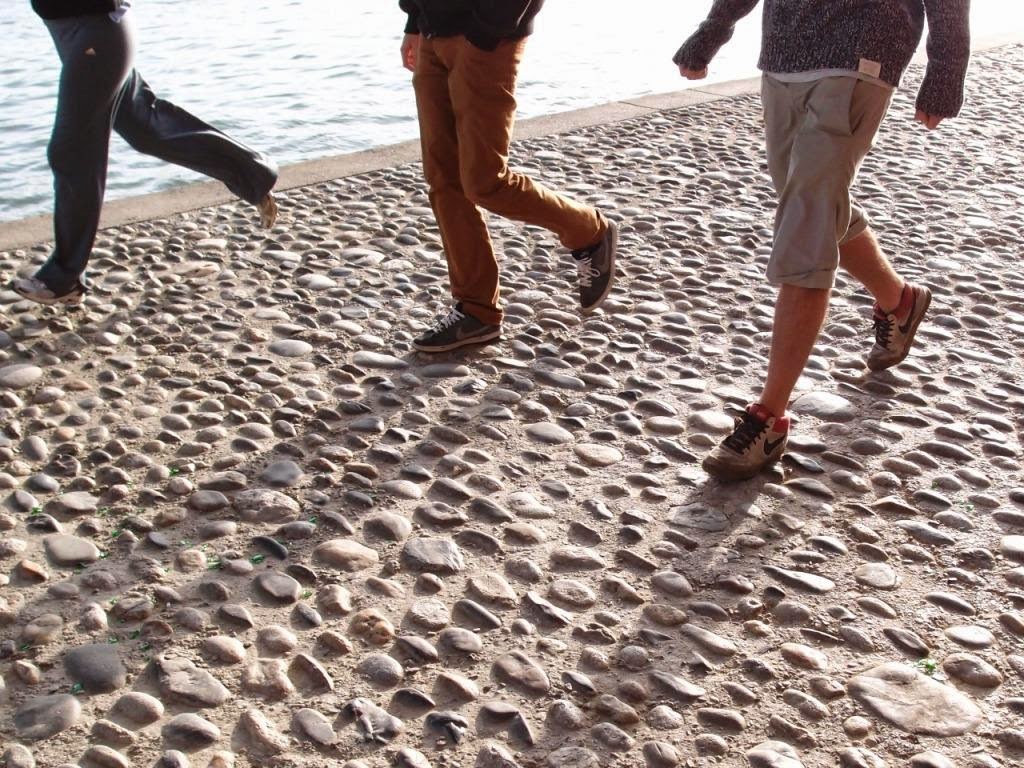
That’s what
the House of Commons Select Committee on Health have told GPs that they should
be telling their patients, according to this report in the Telegraph. Because we
are the some of the world’s most lazy people when it comes to physical
activity. And because walking is good for health (who needs a gym?). And
because practically anyone can do it. And because it’s free. And because you don’t
need any special equipment. And because it’s good for the mind. And because you
can start now, practically wherever you are. And because the National Institute
of Health and Care Excellence (NIce) has said workers should be encouraged to
stand up during meetings, and advised to walk or cycle to events outside their
workplace. And because. And because. (Repeat ad infinitum).
Thursday, 15 January 2015
Walk Further, Live Longer

Actually, not that much further. This study of over 330,000 people from the University of Cambridge, and published in the American Journal of Clinical Exercise shows that,
“doing exercise equivalent to just a 20 minute brisk walk each day – burning between 90 and 110 kcal (‘calories’) – would take an individual from the inactive to moderately inactive group and reduce their risk of premature death by between 16-30%.”
So what are you doing reading this? Go out for a walk. Invest 20 minutes today and increase your chances of living longer.
Wednesday, 27 August 2014
Graphic of the Week

If you happen to be in Pittsburgh PA, from 8th to 11th September 2014, here’s some interesting information from the Project for Public Spaces, including loads of great links to studies on the role of public space, health and happiness. Otherwise, just enjoy this great graphic.
Friday, 15 November 2013
Study shows that walking is key to older blokes avoiding strokes
According to research part-funded by the British Heart Foundation (press release here), and published in Stroke, the journal of the American Heart Association, over-65s who walk for an hour a day reduce their chance of a stroke by a third, while for men walking more than 22 hours a week, the risk is two thirds lower. Given that, in the UK around 152,000 people a year have strokes, which can be fatal, this is dramatic stuff.

The study (which appears to be about blokes, rather than folks) found that it was better to walk further rather than quicker. The 3,435 healthy men aged 60 to 80 were followed in the study for 10 years. They were divided into groups based on how much, on average, each man walked per week. Men who walked eight to fourteen hours per week had approximately a third lower risk of stroke than men who walked less than three hours per week. So no need for power walks, just get out there. And the easiest way to do it? Don’t take the car, take a walk.

The study (which appears to be about blokes, rather than folks) found that it was better to walk further rather than quicker. The 3,435 healthy men aged 60 to 80 were followed in the study for 10 years. They were divided into groups based on how much, on average, each man walked per week. Men who walked eight to fourteen hours per week had approximately a third lower risk of stroke than men who walked less than three hours per week. So no need for power walks, just get out there. And the easiest way to do it? Don’t take the car, take a walk.
Subscribe to:
Posts (Atom)