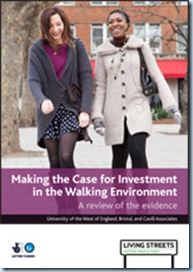
 must take a look at this new report, Making the Case for the Walking Environment, published by Living Streets and produced by a multi-disciplinary team from the University of the West of England and Cavill Associates. The report brings together and evaluates the multiple health, economic, social and environmental benefits of investment in walking friendly public spaces.
Key findings include:
- Investing in walking environments can support local economies by increasing footfall, improving accessibility and attracting new business and events
- Investment in the walking environment is likely to be of equal or better value for money than other transport projects
- Retailers and residents express a willingness to pay for improvements to the walking environment, while good quality public realm increases the value of both residential and commercial property
- Residents of walking friendly neighbourhoods are less likely to be depressed or to have poor mental or physical health
- People walk more when they feel their neighbourhood is safe, well maintained and lively, while increased walking in a neighbourhood is associated with better perceptions of safety and greater social interaction.
The report includes several case studies of schemes based on pedestrian prioritizing, from Melbourne to New York and Copenhagen. Closer to home, it was good to see a name check for Jim Mayor of Brighton and Hove City Council, who contributed information for the report’s Case Study of New Road in Brighton. And this blog has already covered the area around Sheffield Railway Station. This report should be required reading for anyone who cares about improving our urban environment. Not to mention getting better value for money. And improving the state of the economy.


