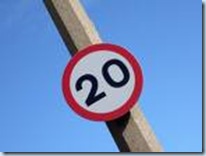
 As today’s Independent points out, Brighton and Hove is going ahead with a 20mph default speed limit in the city centre, joining a growing list of UK cities which has adopted the safer speed. It’s a pity that the Independent chose to frame the article as a loss for Brighton’s taxi drivers. Behavioural economics tells us that the story would have been quite different if the piece had used a different frame: the gain for those of us who walk, cycle, visit, live, or work in Brighton and Hove. Same data, different frame. Spot the difference….
Showing posts with label 20s Plenty. Show all posts
Showing posts with label 20s Plenty. Show all posts
Wednesday, 16 January 2013
Twenty’s Plenty for Brighton and Hove: What A Difference A Frame Makes
As today’s Independent points out, Brighton and Hove is going ahead with a 20mph default speed limit in the city centre, joining a growing list of UK cities which has adopted the safer speed. It’s a pity that the Independent chose to frame the article as a loss for Brighton’s taxi drivers. Behavioural economics tells us that the story would have been quite different if the piece had used a different frame: the gain for those of us who walk, cycle, visit, live, or work in Brighton and Hove. Same data, different frame. Spot the difference….


Wednesday, 9 February 2011
How To Survive A Car Crash
BBC tv’s Horizon programme on surviving a car crash was shown earlier this week (6th February). It was less a useful guide to getting out of trouble, more a look at the research and investment going into reducing the number of car drivers and occupants killed and maimed in crashes.  Timely, considering that road crashes kill over 1 million people a year. Surviving means understanding what happens during a crash. Apparently, a crash has three stages, which happen in milliseconds: first, impact of the car; second, impact of the occupants on the car (and vice versa); third, what happens to all those soft squidgy organs inside the bodies of the occupants after 1 and 2 (particularly the brain - in developed countries, 75% of traumatic brain injuries are apparently caused by car crashes.Not surprising, given one doctor’s description of the brain as, an average of “1.2kgs of jello floating in a bowl of liquid, attached by a few veins and nerves”).
The best way to not be killed (or end up in a persistent vegetative state - described by one medic as “worse than death” is to not get into a car crash in the first place. For this, the only sure fire way is to not get into a car. But, as any student of behavioural economics knows, once inside a car, even the most capable brain can get overloaded, reducing our processing power and producing sub-optimal decisions. When driving a car, such minor mistakes can have major consequences. So it’s a good idea to reduce cognitive distractions which can overload the brain when driving: talking on the phone may not be illegal if it’s hands-free, but it’s ill-advised, even when it’s not against the law. Even at 30mph, a car crash is equivalent to falling off a 3 or 4 storey building. Horizon showed that there’s a Golden Hour after a crash, crucial for arresting injuries. Innovative ICTs are coming to the rescue during the Golden Hour - deploying an ‘urgency algorithm’ to link onboard computers to hospital medical centres; using telemedicine to help ambulance crews; advanced vision technology, augmented reality and GPS-based avoidance systems to reduce the risk of error.
But amongst all these expensive technological solutions, there were a couple of noticeable absences: first, the phenomenon of “risk compensation,” whereby individuals change behaviour in response to perceived changes in risk – from seat belts to anti lock brakes, studies show that drivers adjust their ‘risk thermostats’ to take advantage of these new protections. A Wiki article notes at least three studies which show that drivers’ response to antilock brakes is to drive faster, follow closer and brake later, accounting for the failure of ABS to result in any measurable improvement in road safety. The second omission was any reference to people hit by these increasingly “safer” cars – pedestrians and cyclists, who are largely unprotected. Which underlines the strong case for measures to make sure that drivers don’t trade off their increased safety by increasing risks for more vulnerable groups. Like 20mph default speed limits in urban areas. Twenty’s Plenty, anyone?
 Timely, considering that road crashes kill over 1 million people a year. Surviving means understanding what happens during a crash. Apparently, a crash has three stages, which happen in milliseconds: first, impact of the car; second, impact of the occupants on the car (and vice versa); third, what happens to all those soft squidgy organs inside the bodies of the occupants after 1 and 2 (particularly the brain - in developed countries, 75% of traumatic brain injuries are apparently caused by car crashes.Not surprising, given one doctor’s description of the brain as, an average of “1.2kgs of jello floating in a bowl of liquid, attached by a few veins and nerves”).
The best way to not be killed (or end up in a persistent vegetative state - described by one medic as “worse than death” is to not get into a car crash in the first place. For this, the only sure fire way is to not get into a car. But, as any student of behavioural economics knows, once inside a car, even the most capable brain can get overloaded, reducing our processing power and producing sub-optimal decisions. When driving a car, such minor mistakes can have major consequences. So it’s a good idea to reduce cognitive distractions which can overload the brain when driving: talking on the phone may not be illegal if it’s hands-free, but it’s ill-advised, even when it’s not against the law. Even at 30mph, a car crash is equivalent to falling off a 3 or 4 storey building. Horizon showed that there’s a Golden Hour after a crash, crucial for arresting injuries. Innovative ICTs are coming to the rescue during the Golden Hour - deploying an ‘urgency algorithm’ to link onboard computers to hospital medical centres; using telemedicine to help ambulance crews; advanced vision technology, augmented reality and GPS-based avoidance systems to reduce the risk of error.
But amongst all these expensive technological solutions, there were a couple of noticeable absences: first, the phenomenon of “risk compensation,” whereby individuals change behaviour in response to perceived changes in risk – from seat belts to anti lock brakes, studies show that drivers adjust their ‘risk thermostats’ to take advantage of these new protections. A Wiki article notes at least three studies which show that drivers’ response to antilock brakes is to drive faster, follow closer and brake later, accounting for the failure of ABS to result in any measurable improvement in road safety. The second omission was any reference to people hit by these increasingly “safer” cars – pedestrians and cyclists, who are largely unprotected. Which underlines the strong case for measures to make sure that drivers don’t trade off their increased safety by increasing risks for more vulnerable groups. Like 20mph default speed limits in urban areas. Twenty’s Plenty, anyone?
Wednesday, 29 September 2010
20’s Plenty: The Movie
One thing that would make life a whole lot better for those of us who live in urban Britain would be default 20mph speed limits. This doesn’t seem to be a problem in many parts of Northern Europe, so why is it so hard for local authorities in the UK? There’s overpowering evidence that slowing down the traffic results in fewer deaths and injuries, makes neighbourhoods more sociable, reduces pollution and congestion – and makes our towns and cities a whole lot more pleasant. 
Subscribe to:
Posts (Atom)