A telling statistic from an article by John Lanchester in the Guardian about the “justification” for the surveillance society revealed by Edward Snowden’s leaks about GCHQ, the NSA and the Prism programme. “Since 9/11, 53 people have been killed by terrorists in the UK. Every one of those deaths is tragic. So is every one of the 26,805 deaths to have occurred on Britain's roads between 2002 and 2012 inclusive, an average of 6.67 deaths a day. Let's call that the SDRD, standard daily road deaths. The terrorist toll for 12 years comes to 0.0121 SDRD. This means that 12 years of terrorism has killed as many people in the UK as eight days on our roads.”
Behavioural economics can help explain how this happens. First, the availability heuristic says that we assume that the more available some piece of information is to memory, the more we must have experienced it in the past (and the more likely it is to happen again). So newspaper stories featuring spectacular events like murders or fires or terrorism are vivid, salient and available to memory. And salience and vividness aid ease of recall. If something stands out from everything else, we think it’s more likely to happen. Even if it actually isn’t. Something to think about next time you get in a car. Or the next time a politician invokes the "war on terror."
John Lanchester, “The Snowden files: why the British public should be worried about GCHQ.” The Guardian, Thursday 3 October 2013
Showing posts with label salience. Show all posts
Showing posts with label salience. Show all posts
Monday, 7 October 2013


Thursday, 8 March 2012
Macca In A Muckle: Paul McCartney Gets Stuck On The Eurostar
Sir Paul McCartney was among passengers travelling between Paris and London who got stuck when the Eurostar broke down this week, as heavy snow in France caused problems with the overhead cables. His six hour delay was big news, splashed across most of the newspapers.
Behavioural economists would note that this was a pretty vivid and salient episode, likely to create a lasting impression of Eurostar. This could then feed an availability heuristic: Eurostar is prone to breakdowns (it isn’t the first time this has happened). Such a heuristic could trump the actual data about the reliability of Eurostar, but it’s the heuristic that drives decisions, not the data. When similar things happen on the roads, and people get stuck in their car for hours, the same thing doesn’t happen: people don’t decide not to drive again.
Less vivid and less salient, hence no heuristic to be available for future decisions. As well as the behavioural economics, there’s a more cheering message from this episode: not just that Macca seems to have been pretty equable throughout (he understands that “these things can happen”), but that he chooses to use public transport, and not a private jet. When Macca lived in Hove during his marriage to Heather Mills, he was often spotted taking the train to London. Whatever you think of the music, Macca’s willingness to mix it on public transport has to be a plus.
Behavioural economists would note that this was a pretty vivid and salient episode, likely to create a lasting impression of Eurostar. This could then feed an availability heuristic: Eurostar is prone to breakdowns (it isn’t the first time this has happened). Such a heuristic could trump the actual data about the reliability of Eurostar, but it’s the heuristic that drives decisions, not the data. When similar things happen on the roads, and people get stuck in their car for hours, the same thing doesn’t happen: people don’t decide not to drive again.
Less vivid and less salient, hence no heuristic to be available for future decisions. As well as the behavioural economics, there’s a more cheering message from this episode: not just that Macca seems to have been pretty equable throughout (he understands that “these things can happen”), but that he chooses to use public transport, and not a private jet. When Macca lived in Hove during his marriage to Heather Mills, he was often spotted taking the train to London. Whatever you think of the music, Macca’s willingness to mix it on public transport has to be a plus.
Friday, 17 February 2012
Economics, Behavioural Economics, Cars and Car Clubs
Today, the car club firm Zipcar, which acquired another car club firm, Streetcar in April 2010, is withdrawing its cars from Brighton and Hove and re-deploying them to London: good news for Londoners, and good news for City Car Club, which is now the only car club in Brighton and Hove. As a transitional deal, Zipcar is providing a year’s free membership to City Car Club. And Zipcar members will still be able to hire Zipcars in other locations, both around the UK and in Canada and the US.
 Thinking about Zipcar’s departure from Brighton got me pondering how conventional economics and behavioural economics could help explain what’s going on here. Conventional economics would explain that providing a service like a car club (sometimes known as car share) means sweating the assets to the max – the costs are mainly fixed (capital cost of the car, insurance, cost of the parking bay etc), which makes it important to hire out the cars for as many hours a day as possible. It’s clear from Zipcar’s decision that this is going to be easier when the cars are parked in London. So why weren’t the people of Brighton and Hove using the Zipcars more often?
Behavioural economics (which I teach) can help explain this. A car club is a substitute for owning a car. But giving up your car is not easy: we hate to give things up. Human beings are loss-averse - psychologically, the “pain” we suffer from a loss is more than twice as much as the benefit we feel from an equivalent gain. Adam Smith (picture from wiki), the man on the back of the £20 note, is sometimes described as a prototypical behavioural economist. In the Wealth of Nations he said, "we suffer more... When we fall from a better to a worse situation, than we ever enjoy when we rise from a worse to a better.” Consumers view parting with an already owned good to be a greater loss than the potential gain from acquiring another good of equal value.
In 1979 Daniel Kahneman and Amos Tversky published Prospect Theory: An Analysis of Decision Under Risk.’ This seminal work of behavioural economics charted objective and subjective gains and losses with respect to a reference point, as opposed to the standard utility function of conventional economic theory. The shape of the curves using Prospect Theory illustrates that we focus on what we might lose, rather than what we might gain - thinking about selling something, we think about the things we'll miss, rather than the hassles of ownership. Combined with the status quo bias, this means that people prefer situations to remain static and unchanged. Change of ownership would disrupt the status quo, causing unease.
“Giving up” something like a car feels like a big loss: studies show that the perceived benefits need to be at least double the perceived losses to persuade people to give something up. A consequence of loss aversion is that people tend to place a higher value on a good that they own compared with an object of identical value that they do not own. This is called the endowment effect, and it means that people value things differently depending on whether they are gaining or losing them. Loss tends to be felt more keenly than gain.
And the latter means that ownership weaves it’s own spell, making it even harder to let go: people become attached to objects that are in their possession and are reluctant to part with them, even if they would not have particularly desired the objects had they not been endowed with them.

And there’s something else. Zipcars were pretty discreet. Nice cars, usually VW Golfs. You had to look hard to spot that they were Zipcars. No doubt it was a marketing decision to put them on the street practically unbranded. City Car Club cars are different: the company logo is emblazoned on the side. They get noticed. Unlike Zipcars, they are salient. And salience, the extent to which something stands out from its surroundings, translates in behavioural economics to a tendency to over-weight certain phenomena, which may then account for bias in decision making. Zipcars, lacking salience, weren’t “front of mind.” So maybe fewer people were aware of them, fewer people who might join up and use them, which meant less sweating of those assets. Which was where we came in… And, as far as Brighton is concerned, where Zipcar goes out.
 Thinking about Zipcar’s departure from Brighton got me pondering how conventional economics and behavioural economics could help explain what’s going on here. Conventional economics would explain that providing a service like a car club (sometimes known as car share) means sweating the assets to the max – the costs are mainly fixed (capital cost of the car, insurance, cost of the parking bay etc), which makes it important to hire out the cars for as many hours a day as possible. It’s clear from Zipcar’s decision that this is going to be easier when the cars are parked in London. So why weren’t the people of Brighton and Hove using the Zipcars more often?
Behavioural economics (which I teach) can help explain this. A car club is a substitute for owning a car. But giving up your car is not easy: we hate to give things up. Human beings are loss-averse - psychologically, the “pain” we suffer from a loss is more than twice as much as the benefit we feel from an equivalent gain.
 Adam Smith (picture from wiki), the man on the back of the £20 note, is sometimes described as a prototypical behavioural economist. In the Wealth of Nations he said, "we suffer more... When we fall from a better to a worse situation, than we ever enjoy when we rise from a worse to a better.” Consumers view parting with an already owned good to be a greater loss than the potential gain from acquiring another good of equal value.
In 1979 Daniel Kahneman and Amos Tversky published Prospect Theory: An Analysis of Decision Under Risk.’ This seminal work of behavioural economics charted objective and subjective gains and losses with respect to a reference point, as opposed to the standard utility function of conventional economic theory. The shape of the curves using Prospect Theory illustrates that we focus on what we might lose, rather than what we might gain - thinking about selling something, we think about the things we'll miss, rather than the hassles of ownership. Combined with the status quo bias, this means that people prefer situations to remain static and unchanged. Change of ownership would disrupt the status quo, causing unease.
“Giving up” something like a car feels like a big loss: studies show that the perceived benefits need to be at least double the perceived losses to persuade people to give something up. A consequence of loss aversion is that people tend to place a higher value on a good that they own compared with an object of identical value that they do not own. This is called the endowment effect, and it means that people value things differently depending on whether they are gaining or losing them. Loss tends to be felt more keenly than gain.
And the latter means that ownership weaves it’s own spell, making it even harder to let go: people become attached to objects that are in their possession and are reluctant to part with them, even if they would not have particularly desired the objects had they not been endowed with them.

And there’s something else. Zipcars were pretty discreet. Nice cars, usually VW Golfs. You had to look hard to spot that they were Zipcars. No doubt it was a marketing decision to put them on the street practically unbranded. City Car Club cars are different: the company logo is emblazoned on the side. They get noticed. Unlike Zipcars, they are salient. And salience, the extent to which something stands out from its surroundings, translates in behavioural economics to a tendency to over-weight certain phenomena, which may then account for bias in decision making. Zipcars, lacking salience, weren’t “front of mind.” So maybe fewer people were aware of them, fewer people who might join up and use them, which meant less sweating of those assets. Which was where we came in… And, as far as Brighton is concerned, where Zipcar goes out.
Tuesday, 11 October 2011
Cars and Shopping: Salience, Supermarkets and Farmers Markets
Cash is king, or so they used to say. These days, we mostly use other forms of payment – whether it’s standing orders and direct debits for regular payments or credit cards for pretty much everything else. The move away from cash is a big psychological factor underlying the growth in personal debt - spending money on credit cards is so easy, and it isn't real money, is it? It's also another reason why people prefer to shop in supermarkets rather than in real markets, like this one in Shoreham, West Sussex. It's not just that it’s easy to drive, and park, at a supermarket, but supermarkets take credit cards while real markets tend to deal in cash. 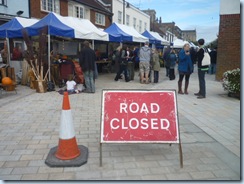 Behavioural economics tells us that salience, the “noticeability” of something, is a key factor when we make decisions. Salience is why marketeer's use attention-grabbing words like 'new' and 'free.' Another type of salience comes with things that hurt - the “ouch” factor that suppliers would prefer to avoid. Cash is salient because handing over hard earned notes creates pain that we’d prefer to avoid. Unless, of course, you prefer to live within your means, pay as you go, and keep a grip on how much you’re actually spending. In which case….get yourself to a market a.s.a.p.
 Behavioural economics tells us that salience, the “noticeability” of something, is a key factor when we make decisions. Salience is why marketeer's use attention-grabbing words like 'new' and 'free.' Another type of salience comes with things that hurt - the “ouch” factor that suppliers would prefer to avoid. Cash is salient because handing over hard earned notes creates pain that we’d prefer to avoid. Unless, of course, you prefer to live within your means, pay as you go, and keep a grip on how much you’re actually spending. In which case….get yourself to a market a.s.a.p.
Saturday, 20 March 2010
The Price of Petrol
I know that the price of petrol is on the up again. How come, given the header to this posting? It’s because every time the price of fuel goes up, I get a media request for a comment. Which is a bit ironic: being carfree, I have absolutely no interest in the price of petrol - petrol prices are just one more thing that I don’t have to worry about. But I am interested in why most of us are so interested. Just why do car owners get so excited about the price of petrol? You’re probably thinking that the answer is obvious. But the actual answer is probably different from the one you’re thinking of, and behavioural economics can tell us why. Thinking about the cost of owning and running a car, means we should think about significance – the things that really matter.
What we actually think about is salience – the things that we think matter. When it comes to costs, the things that really matter are the cost of buying the car and the subsequent depreciation it undergoes, the cost of insurance, membership of rescue organisations, annual parking fees etc. These are the big ticket items that cost the most money. Often, they are paid annually, or by direct debit, so they are not that obvious to us. Some we don’t even notice – like depreciation. But the thing that we do notice, because it is most salient, is the cost of petrol – the pain we suffer each time we splash out to top up the tank. It happens quite frequently and it is very noticeable, especially if we pay cash. Of course, what makes the price of petrol even more salient, even more top of mind, is all the media interest it attracts. Which I guess is where I started…..
What we actually think about is salience – the things that we think matter. When it comes to costs, the things that really matter are the cost of buying the car and the subsequent depreciation it undergoes, the cost of insurance, membership of rescue organisations, annual parking fees etc. These are the big ticket items that cost the most money. Often, they are paid annually, or by direct debit, so they are not that obvious to us. Some we don’t even notice – like depreciation. But the thing that we do notice, because it is most salient, is the cost of petrol – the pain we suffer each time we splash out to top up the tank. It happens quite frequently and it is very noticeable, especially if we pay cash. Of course, what makes the price of petrol even more salient, even more top of mind, is all the media interest it attracts. Which I guess is where I started…..
Subscribe to:
Posts (Atom)