Showing posts with label Carfree. Show all posts

Monday, 3 July 2017

RIP Heathcote Williams


Sad to read of the death of Heathcote Williams, author of, among other things, the epic anti-car poem Autogeddon, some of which you can read here. 

Hard not to love a work that contains the line “Exile on Maim Street.”


Monday, 26 October 2015

Carfree: Jeremy Corbyn MP, Leader of HM Opposition


There are many extra-ordinary things about Jeremy Corbyn, recently elected leader of Britain’s Labour Party, and hence, Leader of HM Opposition: his support for nuclear disarmament and opposition to renewing Trident, his failure to endorse ‘austerity-lite’, his campaign against the Iraq war, his election to the Labour leadership with 59% of the vote, his ranking as the MP with the lowest expenses claim (although somebody has to be at number 650 on that list), and his choice of attire. Almost as remarkable, and rather less remarked upon, is that he does not own a car (according to Wiki and the Financial Times). 

As the FT article notes,

“When not attending rallies, constituency meetings and picket lines, Corbyn likes to tend to his allotment, make jam, eat cheese and read about railways. He seldom drinks and does not own a car, preferring to cycle. He is also a keen photographer of manhole covers.” (apparently, as long as they were installed by public sector bodies).

What we do not know is whether this is because Jeremy Corbyn is a Rational Economic Man. Has Mr Corbyn applied the textbook nostra of the Standard Economic Model, carried out a cost-benefit analysis and decided that the downside of owning a car (cost, hassle, risk) outweighs the upside (convenience, some of the time). Does he just prefer to be on his bike or on foot? Perhaps he has he never learned to drive – it’s a useful life skill, as there are times when it’s hard to find an alternative to using a car. You just don’t have to own one. Is it because, as a man of the people, Mr Corbyn sees car ownership, life in a box on wheels, as insulating him from the rest of  humanity?  Or maybe it’s a refusal to be part of oil-fuelled corporate capitalism, with its oil dependency, resource wars and implications for foreign policy.

Whatever the answer, it’s hard to believe that there has been any other Leader of the Opposition since the Second World War who hasn’t owned a car. So is the carfree Mr Corbyn hopelessly out of touch? Or ahead of the curve? (picture: Wikipaedia)

Saturday, 6 June 2015

Carfree economic rockstar


Yo! I’m an economic rockstar. Apparently. Have a listen to the podcast and find out about economics, behavioural economics, being carfree and more. Yeah, yeah, yeah.  

Monday, 2 March 2015

Twenty Carfree Years – More Gain than Pain


If there’s any significance to anniversaries, then last weekend marked a biggie for me. Because it was 20 years ago that I gave up owning a car: it happened on 28th February 1995. On that day I drove up to Liverpool in my company car. I was there to attend the funeral of a young woman who was not just a colleague but also a friend. After the funeral I drove the car to the garage of the company’s fleet manager, handed in the keys, and left it there. I haven’t owned a car since.

Why did I give up the car? The timing of the funeral was accidental in that the lease on the car just happened come to an end at the same time. But there was also a need to do something positive on a sad day. I could have taken the line of least resistance - with my (then) pay package I could have replaced the car with something swish and probably German. But rather than drive out of the garage in a new Beamer, I had done the maths, had a long think and made the choice to give up on owning a car. I went home on the tube....and thus began my carfree  life.

Of course, ‘carfree’ is a bit of a misnomer. There is no car permanently in our household, but our life is not devoid of cars - for a start, we often use taxis. And sometimes a car is the best way to get from A to B. So we sometimes hire a car from City Car Club or, for longer trips, from one of the national car rental chains. 


Sometimes a car is the only way to go - if you're in Tasmania, there is very little public transport, so a hire car is (or was) the only sensible way to get around. And if you need to go from Los Angeles to San Francisco, with some stop-offs along the way, you can’t really do better than point a convertible up Highway One. But, exceptions like these aside, it’s been twenty years since I had to deal with the hassle and expense of being a car owner. 

On reflection, what has been most amazing is just how infrequently I find myself thinking, “A car would be really useful today.” It happens occasionally, but mostly, there is more gain than pain - I’m better off, fitter, thinner and more relaxed than I would be if I still had four wheels parked outside. And that’s before even mentioning the environment. In a nutshell, the lesson from my 20 carfree years (apart from, why don’t more people do it?) goes like this: being able to drive is a useful life skill. You never know when it might come in handy. But that doesn’t mean you have to own a car. After all, when you want a pint of milk, you tend not to go out and buy a cow.

Wednesday, 24 December 2014

Merry Carfree Christmas

Hovewreaths1

If you’re a fan of Christmas wreaths, there are some fine specimens adorning the front doors of Hove. The closer you can get, the better you’ll see them – which means not being in a car. Obviously. Merry Christmas!

Friday, 14 November 2014

Carfree London: Why Not?

Canada 2004 com How is it possible to improve the quality of life in the capital, reducing pollution, congestion, the number of people killed and seriously injured in road crashes, and make London a better place for its residents, workers and visitors? There’s a campaign run by Rosalind Redhead at banprivatecarsinlondon.com, or if you prefer to take the streets, there is a 'National funeral for the unknown victim of traffic violence,' a symbolic funeral march from Bedford Square to Marble Arch, on Saturday 15th November from 12:00 - 15:00.

Wednesday, 12 November 2014

Follow up to The Big Debate on banning cars in Brighton city centre

A few further thoughts on the Big Debate about whether cars should be banned from Brighton city centre.


A car “ban” is rarely total
“Banning cars” normally means that the city centre is accessible by automobile only to residents, taxis, police, service vehicles, and delivery vehicles.


Many great cities have implemented a ban

Cities that have banned access, as described above, include: Turin, Vienna, Salzburg, Ghent, Dubrovnik, Copenhagen, Munich, Stuttgart, Zurich, Lausanne, Geneva, Basel, Quebec City, New York Broadway in Times Square and Herald Square, Adelaide.


P9092265 com 
Photo shows one entrance to the Limited Traffic Area (ZTL) in Turin – home of the Italian car industry (bikes are allowed).
Active Travellers spend more
The data increasingly shows that pedestrians and cyclists out-spend car borne shoppers. The most recent collected source is independent research commissioned by Living Streets, published here.

Key findings from that research:
  • Making places better for walking can boost footfall and trading by up to 40%
  • Good urban design can raise retail rents by up to 20%
  • International and UK studies have shown that pedestrians spend more than people arriving by car. Comparisons of spending by transport mode in Canada and New Zealand revealed that pedestrians spent up to six-times more than people arriving by car. In London town centres in 2011, walkers spent £147 more per month than those travelling by car
  • Retailers often overate the importance of the car – a study in Graz, Austria, subsequently repeated in Bristol found that retailers overestimated the number of customers arriving by car by almost 100%
  • Landowners and retailers are willing to pay to improve the streetscape in order to attract tenants and customers.
Active travel reduces harms and economic costs
Other economic consequences of increasing walking and cycling include:
  • reducing the impact of poor health from inactivity
  • cutting the number of casualties through measures such as 20mph defaults and similar measures
  • distributional effects from helping people to save money by choosing the cheapest ways to get about: foot and bike.
An interesting item from The Economist last year cites figures from TfL indicating that pedestrians spend an average of £373 ($571) a month, compared with £226 for drivers.
The Economist article concludes, "Ailing high streets and town centres need to win back walkers. Learning from London's incentives would be a start" and goes on to cite the 2004 plan to make London a “walkable” city.

For ‘London’, read ‘Brighton.’

Wednesday, 29 October 2014

To ban or not ban cars in the city centre – The Big Debate from Brighton and Hove Chamber of Commerce

Last week, the Brighton and Hove Chamber of Commerce hosted a Big Debate on the subject, 'Business would be better in Brighton if we took cars out of the city centre.' The debate attracted a large audience to the Main Hall at City College Brighton and Hove, where speakers from the panel and from the floor covered a wide range of issues surrounding transport in the city and the effect on businesses.

Chaired by journalist and media coach Steve Bustin, the debate kicked off with four ‘points of view,’ contributed by Anthony Probert of BioRegional; Anne Martin, general manager of Brighton Pier; Martin Williams of Mayo Wynne Baxter; and Chris Todd of Brighton and Hove Friends of the Earth. I was invited along to give a Living Streets perspective.

What was interesting was that, after the debate, the vote was finely balanced between the ‘ban cars’ vs the ‘don’t ban cars’ factions. The evidence that more cars don’t equal more prosperity seems to be having an effect.  Equally fascinating was the result of the final vote on the question “Do you think it’s essential to own a car in Brighton and Hove?” Not a single person said yes.

Comprehensive coverage of the debate in the Argus, here.

Monday, 29 September 2014

Carfree Reflections on Rotterdam

SNAP IMG_9605
Just back from giving a presentation on behavioural economics at the conference of the European Social Marketing Association in Rotterdam. The conference (of which, more here) was all about behaviour change, and when it comes to getting people to build more physical activity into their daily lives, there are few better observatories than the Netherlands.
P9215979 crop com

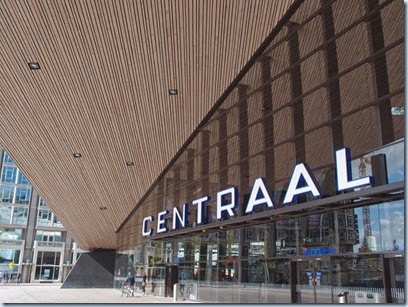
Rotterdam is a city of 600,000 people, and home to the world's second-biggest port (it used to be the biggest, until Shanghai pipped it to the post). Rotterdam has a metro, trams, a good bus network, and several main line rail stations, including the extraordinary Centraal station (pictured above and below). A 3 day €14 ticket gets you unlimited access to the metro, buses and trams.
P9215983 com

Of course, there are cars in Rotterdam, but they are not allowed to be dominant. Rotterdam is a city which has been configured for people on bikes and people on foot. It's a city with lots of green and lots of water, where people are purposeful. But it’s also a noticeably calm city - presumably a result of effective public transport, those endorphins from active travel, and not being forced to breathe an invisible miasma of traffic fumes.

SNAP IMG_9658

As well as the Dutch default of segregated cycleways, Rotterdam also has extensive pedestrianisation, including Europe's first pedestrianised shopping street, Ljinbaan.

photo

Active travel in Rotterdam means that trams and buses have priority, and cars are required to give way to bikes and pedestrians. That's down to urban planning, street design and people-friendly liability laws that favour the non-mechanical over the mechanical. What a delight, as a pedestrian, to press the button at a traffic crossing and get an immediate green man signal. Over time, it’s not just the cityscape, but the culture that changes. And one other thing we observed: anecdotal evidence, maybe, but we saw very few overweight people and only a few that could be described as obese. UK health officials, take note!

Wednesday, 4 June 2014

Brompton Dock – offer for readers of this blog

brompton dock3 com
I’ve received details of an offer from the guys at Brompton Dock – a ‘pick up, unfold, ride off, fold up and return’ bike hire service based on Brompton folding bikes. If you register with Brompton Dock by the end of June 2014 for £1 you can get two days of free cycle hire with this promotion code - Free2Ride. The bikes are available in many UK locations (although not yet in Brighton & Hove), and can even be picked up at one Dock and dropped off at another.
brompton dock 2 com
Why does this service deserve a puff? Speaking as a Brompton-ian, folding bikes make it even easier to be carfree – folding bikes can be taken on all public transport, even during peak times. More details here.

Monday, 13 January 2014

Carfree: The late Simon Hoggart

Simon Hoggart’s daughter Amy wrote this about her father, who sadly died last week, in Saturday’s Guardian.

“During an emotional moment for me I asked him though my tears whether he had any life advice. He squeezed my hand and thought for a while before answering: "When you change a tyre, make sure you unscrew the bolts first before lifting the wheel."

Firm advice from a man who – as my mother was quick to point out – has never owned his own car, let alone changed a tyre in his life.”
Photo: The Guardian

Monday, 9 December 2013

Carfree: Tim Lott

A couple of weekends back the Guardian Family section was devoted to The Family Car – “our second home”!

It was good to see the alternative – the non-car family – in a front page piece by Tim Lott. Here’s an extract from his article.

clip_image001

“Last year we sold the family car. It has been an enormous improvement in our quality of life. No parking tickets, no traffic jams. No children vomiting at 70mph. No tussles with my wife about whether to take the motorway or the scenic route, no rows about whether the windows should be open or closed, the air conditioning on or off, the heater high or low…..to rid ourselves of this most visible and expensive of consumer durables has been surprisingly easy, and remarkably pleasant. We travel on buses and trains and bicycles for the most part, and it is altogether safer, more enjoyable and considerably cheaper.”

(My bold).

Photo: The Advertising Archive (or should that be ‘Carchive’?)