Showing posts with label ITU. Show all posts
Showing posts with label ITU. Show all posts
Wednesday, 21 September 2011
Quote of the Week
In my work as a consultant to a UN agency, the International Telecommunication Union, I was recently required to take a couple of short online courses on “Security in the Field.” Among the topics covered were how to deal with child soldiers in the field (never, but never, ask if you can take their photo), how to find North using a wristwatch (an old Boy Scout trick), and what to do when people start shooting into the air (find some thick concrete and get under it). Less dramatic, but equally sound, was what to do with food from dubious sources (“Boil it, cook it, peel it, or leave it.”) All useful stuff, which I hope I’ll never need it. One of the most striking bits of information was that “Over 50% of hostage victims are taken from vehicles.” Good enough to be Quote of the Week. And a great reason to try and avoid getting in a car when you’re somewhere dodgy.


Thursday, 8 September 2011
Outside The Box in Beijing
During the last couple of years I have been contracted as a consultant to a UN agency, the International Telecommunication Union, for whom I have written studies on climate change and the ICT sector. The ITU recently asked me to give a presentation as an expert on such matters at a seminar on green ICTs in Beijing, co-hosted by the ITU and China's Ministry of Industry and Information Technology. It would have been rude to refuse, so I duly turned up in Beijing last week, having decided to tack on a couple of extra days – my first visit to Beijing being a chance to check out the capital of the next global superpower (ironically, videoconferencing did not seem to be an option).  Beijing catapulted into public prominence during the 2008 Olympic Games, which saw a boom in construction with iconic structures like the Bird’s Nest stadium. Less visible, but more useful was the expansion to the Beijing Subway, which is still ongoing. The subway
  is fast, frequent, clean, air-conditioned, extensive, inexpensive (2 CNY or about 20 pence, to go anywhere) and seems efficient. Many of the stations have public toilets, and the trains have illuminated maps to show progress, plus announcements in English. It's also the only subway system I've encountered where bags are x-rayed in a security check before you descend to the platform -
  presumably a bit more of the Olympic legacy (although the operators seemed pretty bored, and I never saw anyone stopped for a closer inspection). If you don’t mind sharing the train with what sometimes feels like a large part of Beijing’s 22 million population, the subway is definitely the best way to stay cool and beat the sprawl in this global megacity.
 Beijing catapulted into public prominence during the 2008 Olympic Games, which saw a boom in construction with iconic structures like the Bird’s Nest stadium. Less visible, but more useful was the expansion to the Beijing Subway, which is still ongoing. The subway
  is fast, frequent, clean, air-conditioned, extensive, inexpensive (2 CNY or about 20 pence, to go anywhere) and seems efficient. Many of the stations have public toilets, and the trains have illuminated maps to show progress, plus announcements in English. It's also the only subway system I've encountered where bags are x-rayed in a security check before you descend to the platform -
  presumably a bit more of the Olympic legacy (although the operators seemed pretty bored, and I never saw anyone stopped for a closer inspection). If you don’t mind sharing the train with what sometimes feels like a large part of Beijing’s 22 million population, the subway is definitely the best way to stay cool and beat the sprawl in this global megacity.
Thursday, 18 November 2010
Dakar Without A Car...and Not Submerging The Maldives
Owning a car wouldn’t have made much difference to a trip I made last week, when I went to Dakar. I suppose I could have followed in the tyre tracks of the Paris-Dakar rally, but instead I took the soft option, and flew. I was speaking at the 10th Global Symposium for Regulators (GSR), a gathering of ICT regulators run by the International Telecommunication Union (ITU) which is a specialised agency of the United Nations. I’ve undertaken a study for the ITU on Climate Change, ICTs and Regulation, and went to Dakar to deliver the paper. (Both are available from the ITU website: Discussion Paper and Slides). After a sleepless night on a couple of planes, arriving in Dakar at 2am, getting through customs and immigration at 3am, the last thing you want to hear is “You don’t have a room at the hotel.”
Which is what happened, despite having a confirmed reservation. What I (and probably the hotel) hadn’t banked on was that President Wade of Senegal would turn up to open the GSR, and, with his entourage, seemingly occupy most of the hotel – including my room. Bailing out to another hotel at 4am would not have been my choice, but there are times when you just have to recognise the overwhelming might of state power. This became abundantly clear with the number of soldiers on duty at the conference.
I have spoken at a lot of telecoms conferences but never in the company of so many armed guards – I hadn’t realised telecoms regulation was so controversial!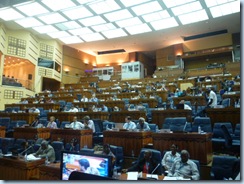 As I delivered the study, the moderator on my panel was, appropriately enough, the telecoms regulator from The Maldives – that chain of atolls in the Indian Ocean that is the world’s most low-lying country. Averaging 1.5 metres above sea level, all of the 1,192 islands of the Maldives are likely to disappear if sea levels rise as predicted. To dramatise what might happen, the Maldives Government has already held a Cabinet Meeting under water. It's ironic that the biggest industry is international tourism, based on climate-changing jet aircraft. But with a population of around a third of a million, the people of the Maldives are not in control of their climate destiny - we are. Something to think about next time you jump in a car, or step onto a plane, wherever you might be going.
Which is what happened, despite having a confirmed reservation. What I (and probably the hotel) hadn’t banked on was that President Wade of Senegal would turn up to open the GSR, and, with his entourage, seemingly occupy most of the hotel – including my room. Bailing out to another hotel at 4am would not have been my choice, but there are times when you just have to recognise the overwhelming might of state power. This became abundantly clear with the number of soldiers on duty at the conference.
I have spoken at a lot of telecoms conferences but never in the company of so many armed guards – I hadn’t realised telecoms regulation was so controversial!
 As I delivered the study, the moderator on my panel was, appropriately enough, the telecoms regulator from The Maldives – that chain of atolls in the Indian Ocean that is the world’s most low-lying country. Averaging 1.5 metres above sea level, all of the 1,192 islands of the Maldives are likely to disappear if sea levels rise as predicted. To dramatise what might happen, the Maldives Government has already held a Cabinet Meeting under water. It's ironic that the biggest industry is international tourism, based on climate-changing jet aircraft. But with a population of around a third of a million, the people of the Maldives are not in control of their climate destiny - we are. Something to think about next time you jump in a car, or step onto a plane, wherever you might be going.
Subscribe to:
Posts (Atom)